
Blog de Fresh Hope

Historias y Perspectivas para una Vida Llena de Esperanza
Archivos

Suscríbete a nuestro blog

Publicaciones Recientes

This is the third post in our series featuring excerpts from Outcast, a book by guest contributor Amy Zabel.

There have been many moments when I’ve felt worn—especially after experiencing symptoms of an episode, only to discover the devastating toll it took on my family. How do I comfort them? Where do they get the support they need? How do they recover from the effects of extreme stress caused by my symptoms? I know there are countless families that have experienced—or are experiencing—the wild ride of loving someone with a diagnosis.

This post is for you.

This is to show the gratitude, respect, and love you deserve. So, bring it in for a group hug in print. You’ve earned it. You’re worn, too. Those with a diagnosis are consistently reminded of the importance of self-care. We’re told that self-care is not selfish. This is also true for family members and friends. If you can convince yourself to take time away from the care and concern for the one you love, I assure you it will make tough times easier whenever they arise. Find activities you enjoy and make time for them. Seek out people who encourage you and bring you peace and understanding. Enjoy the beauty of God’s creation whenever possible. Look for ways to find peace in your life to calm the chaos that a mental health condition can sometimes bring to your family.

It’s essential to find someone you can trust—someone who can show you love even without complete understanding. We can’t always comprehend what someone else is going through, but we can still love them. My favorite movie, “A River Runs Through It,” taught me this through witnessing the struggles of the family depicted in the film. Now, I live near a local river, and everything has come full circle for my family as the river runs through our shared experiences. Some of the most important lessons we’ve learned include how to love without complete understanding, how to trust each other, endure, and take time for ourselves when we’re feeling worn.

If you’re a friend or family member of someone with a mental health condition, you probably already know how important it is to respect their dignity and privacy. Don’t report to others everything that is happening to you and your loved one in a crisis. It can come off as “gossip.” It’s easy to be manipulated by emotions when they run high, so look for ways to stay peaceful as you navigate challenging situations. I’ve felt betrayed in this way a few times. It has fractured friendships and close family relationships when I felt I was not loved without complete understanding. I lost my dignity because of conversations that took place behind the scenes. It was like a game of “telephone.” The truth of the story always gets lost—and the victim gets hurt.

As a supporting family member, you need to find someone you can trust, too. Doing so will be highly beneficial to both you and your loved one. If a crisis arises, it’s essential to have a safety plan. I wrote such a plan and shared it with those I care about most, so we can remain safe during a crisis and perhaps prevent one from happening. I would not have the strength to share my story without the love and understanding of family and friends. The ones who never thought I was “too much.” The ones who stayed with me through all the ups and downs. The ones who prayed for me. The ones who stayed with me after a crisis to love me in everyday life. The ones who are still doing the same. These are the people who know how to love without complete understanding.

Our own healing often comes from a place of serving others. This is what Jesus did, and this is the example that He wants us to follow. Thank you to those who sometimes feel worn because of us.“Do not let any unwholesome talk come out of your mouths, but only what is helpful for building others up according to their needs, that it may benefit those who listen.”

– Ephesians 4:29

Comparte esta publicación:

When a Mental Health Diagnosis Returns

Por Peggy Rice, Entrenadora de Agentes de Esperanza para Fresh Hope

It began on a Thursday afternoon. This was my time—set aside for just me and whatever I wanted to do. It was a recent margin I’d built into my week—an afternoon alone, while my husband was gone volunteering, and the time was all mine to do as I pleased: read, crochet, listen to music.

I chose to lie on the couch with the blanket pulled over my head.

I recognized the behavior almost at once. This was old behavior—from 18 years ago.

So I called my psych nurse, the one who manages my meds, and through her assistant, got the message to and from her that my depression was returning, and I probably needed to increase my antidepressant.

It descended as a blanket of depression that afternoon. Or, as my husband described it later, it was as if I drove off a cliff. It happened that fast. Within four hours.

Or did it? Hadn’t it been building all year?

A year of making withdrawals from my emotional tank. I’d been trying in recent weeks to identify boundaries and margins and protect that emotional space, but I was already depleted, and each withdrawal was taking more, until there was just. none. left.

January–March: dealing with chronic pain.
April–June: helping aging parents who live far away.
July: vacation, but it was too long away from home, too hot, too much.
August: recognizing ongoing communication patterns in myself, my marriage, and my family—hard soul-searching efforts and discussions.
September: two particularly difficult days, and the last of my emotional reserves were all used up.

So maybe this afternoon of October 1st, curled up on the couch under the blanket, wasn’t really a surprise after all. I’d been calling it “emotional depletion,” but I knew enough to mention it to my psych nurse at my three-month check-in, so when I called 20 days later, she wasn’t completely surprised that it had gotten darker and deeper.

Thursday evening, I was irritable and crabby. It felt like I was looking at everything around me through sunglasses—everything had a darker shade to it.

Friday I increased my meds. But it’s gonna take a while for me to notice any effects. So a beautiful day in the mountains wasn’t complete joy—I had to really focus and practice staying in the moment, or my negative thinking would swoop in.

And perhaps that’s what surprised me the most—how quickly depression thoughts returned!

I’ve been practicing “thinking about what I’m thinking about” for years. Taking every thought captive unto Christ. Replacing negative self-talk with the truth of God’s Word. I’ve been practicing this, and teaching it to my Fresh Hope group, for years. I have charts and handouts with “not this thought—think this instead.”

But the thoughts that depression brings are their own monster.

I was thinking things on the e-bike ride in the mountains that never would have entered my mind two days prior! Like, as we rode behind the hospital, “Is there a psych ward there? If I checked in, could they make this go away in a day or two?” Or, “Here we go again. And it’s only going downhill from here. Might not go away this time.” Or, “I’m such a downer to anyone around me.” There were many such thoughts, just in an hour.

I remember my therapist from 18 years ago telling me that those weren’t my thoughts. That it was depression talking. And honestly, I accepted him at his word, but didn’t really believe it.

Until now.

Because these things I was thinking were so out of character for me. They were nothing I would have said to myself on Wednesday. And here on Friday, they entered my mind unbidden and sounded almost like truth.

Praise God that I had been practicing talking God’s truth to myself over these past several years, because I was able to recognize that the thoughts didn’t reflect what I actually believed. It was depression distorting the way I was seeing myself and my future—depression whispering in my ear. The thoughts still came, but I didn’t have to accept them as truth.

One of the hardest things about this is that I’ve been depression-free for eight years. Eighteen years ago, I went through a 10-year journey, in and out of depressive episodes. And with the exception of a brief hiccup last spring, when my psych nurse and I dropped my single antidepressant too low, I haven’t felt sad or down or depressed.

Even that brief situation with the lower dose only lasted a week, and it didn’t feel like this. Then, I was just sad—extremely sad. But this time, it’s all the old “feels.” All the familiar patterns and thoughts and emotions that plagued me for 10 years.

It’s almost like an old friend, in its familiarity and, dare I say, comfort?

No, it’s not comfortable.

More like putting on my old ratty sweatshirt with holes and stains and tears. Ugly, yet somehow comfortable.

I’m trying not to give in to the comfort. Because it’s not true—it’s a false comfort. It’s a lie. Again, it’s those whispers that depression is telling me:

“Come closer. Sit down. Remember what this feels like.”

Whispers of a Siren’s Song, luring me until I crash into the rocky shore.

No, I don’t want to remember.

I want to fight. I want to stay emotionally healthy. Mentally healthy.

But fighting looks different to me now than it did 18 years ago.

This time, I recognized what was happening. I made the phone call. I told my husband. I increased my medication as directed. I went to the mountains even though depression came along for the ride. And when the thoughts came, I noticed them. I named them. I challenged them with what I know to be true.

I don’t know how long this episode will last. I don’t know whether the medication change will be enough or whether there will be more steps ahead. And I’m trying very hard not to let depression answer those questions for me.

Because depression wants to tell me that I’m back where I was 18 years ago.

But I’m not.

Those eight years of emotional and mental health didn’t disappear on Thursday afternoon. Neither did everything I learned during the 10 difficult years that came before them. I’m not starting over. I’m starting from here—with experience, tools, people who know what’s happening, medical help, and a faith that has been tested before.

And maybe that’s what fighting looks like today.

Not pretending I’m okay. Not demanding that I feel better tomorrow. Not believing every thought that enters my mind.

Just doing the next healthy thing.

And then the next one.

If you’ve been doing well for a long time and suddenly find yourself facing familiar symptoms again, maybe you need to hear what I’m telling myself right now:

A recurrence does not erase your recovery.

Reach out. Tell someone. Call your doctor. Use the tools you’ve learned. And when your diagnosis starts whispering that everything you’ve gained is gone, remember: you are not standing where you stood the first time.

Neither am I.

And today, that gives me hope.

If you’re struggling, reach out to your doctor or a trusted person. In the US, you can call or text 988 to reach the Suicide & Crisis Lifeline.

About the Author: Peggy ha colaborado con Fresh Hope como facilitadora de grupos durante más de 8 años y como entrenadora de agenes de esperanza (Hope Coaches) durante más de 6 años. Puedes ponerte en contacto con ella en peggy@freshhope.us.

Comparte esta publicación:

Saying Goodbye to Your Therapist

Por Peggy Rice, Entrenadora de Agentes de Esperanza para Fresh Hope

There are relationships in our lives that are difficult to explain to someone who hasn’t experienced them. I think the relationship with a good therapist can be one of those.A therapist knows things about us that many other people don’t. They have sat with us through some of our hardest moments. They may have watched us cry, wrestle, get angry, make progress, go backward two steps, and then move forward again. They know pieces of our story that we do not tell many people.

And then, sometimes, we have to say goodbye.

I recently had to say goodbye to a therapist I trusted deeply. The ending wasn’t because therapy had gone badly. In many ways, that made saying goodbye harder. She was leaving the practice where I had been seeing her, and I had to face the reality that this relationship, at least in the form I had known it, was ending.

There is grief for me in that. And the strange thing is, I can’t process my grief with her—which is exactly what I long to do. Because she knows me so well. She would be able to help me make sense of what I’m feeling and help me figure out what steps I might take next to get through it.

Except she is the person I am grieving.

We often think about therapy as something clinical: You make an appointment. You talk for an hour. Your insurance gets billed. You go home.

But when therapy is good, something much more profound happens in that room. Trust develops. Someone learns your story. They remember where you have been. They recognize your patterns. Sometimes they see growth in you before you can see it yourself.

And when that relationship ends, I think part of saying goodbye is looking back.

Who was I when I first walked into that therapist’s office? What was I carrying? What have I learned since then? What can I do now that I couldn’t do before? What truths have become part of me rather than something my therapist has to remind me of?
For me, I started seeing this therapist when I was experiencing chronic pain. She understood—she deals with chronic pain of her own. And I wanted a therapist who knew chronic pain AND knew the Lord, because my faith in Jesus is an integral part of who I am. I wanted a counselor who would intuitively understand that part of me without having to explain my faith, my worldview, or why those things affected the decisions I made. This therapist loves the Lord, too, so we had that in common.
Over time, we moved from discussing how to serve the Lord while dealing with pain to issues around aging, family, relationships, and communication patterns.

She taught me that “courage is doing something scared.” And her faith in me helped me push past some fears and have difficult conversations. I did them scared, with lots of prayer that God would be my courage and strength.

And He was. He is.

I was sharing with a friend recently that the two therapists I’ve had whom I consider really “good” had something important in common. I could spill all these jumbled pieces out in front of them, and somehow they could take those pieces, make sense of them, and give them back to me with some order and structure. Suddenly, I could understand myself a little better.

That is a remarkable gift.

And maybe that is why saying goodbye to a good therapist really does involve grief. You aren’t just losing an appointment on your calendar. You are losing a particular person who knew how to sit with the jumbled pieces of your life and help you make sense of them.

So that loss deserves to be acknowledged.

I think one of the things I am learning through this experience is that ending therapy well means allowing yourself to feel whatever the ending brings. Gratitude and sadness can exist at the same time. You can know that something has been very good and still grieve that it is changing.

But maybe there is another gift hidden in the goodbye.

It gives us an opportunity to recognize that the work we did in therapy doesn’t belong to the therapist.
It belongs to us.

The insights we gained are ours. The healthier patterns we practiced are ours. The boundaries we learned to set are ours. The hard truths we finally faced are ours. The courage we learned to practice is something we can keep practicing.
A good therapist may have helped us discover those things, but we get to carry them with us when we leave.
For those of us living with a mental health diagnosis—or loving someone who does—there can be another concern: What happens if I need help again?

Ending with one therapist doesn’t mean we will never need therapy again. It doesn’t mean we’ve graduated from needing support. It simply means that this particular season and this particular therapeutic relationship have come to an end.
And perhaps part of ending well is knowing that asking for help again someday will not erase the progress we have made.
But I also know I am not walking into whatever comes next alone. The therapist who has walked beside me may no longer be there in the same role, but God is. He was with me before I walked into her office, He was present in the work we did together, and He will be with me in whatever comes next.

And there are other kinds of support along the way, too. Therapy is one important part of the mental health journey, but it doesn’t have to be the only one. Peer support, like what we find in Fresh Hope groups, gives us a place to be known, encouraged, and reminded that we don’t have to navigate our mental health journeys alone.

So if you are approaching your last appointment with a therapist who has mattered to you, don’t feel as though you have to treat it like just another appointment.

Talk about the ending.

Say what the relationship has meant to you. Talk about what you have learned. Ask what your therapist has seen change in you. Talk about what you want to carry forward. And if you’re sad, let yourself be sad.
Goodbyes are sometimes painful precisely because something has been good.
And maybe the goal isn’t to leave without sadness.

Maybe the goal is to leave knowing that what happened in that room mattered—that we carry what we learned with us, and that the God who met us there will be with us in whatever comes next.

Peggy ha colaborado con Fresh Hope como facilitadora de grupos durante más de 8 años y como entrenadora de agenes de esperanza (Hope Coaches) durante más de 6 años. Puedes ponerte en contacto con ella en peggy@freshhope.us.

Comparte esta publicación:

Explorar Todas las Publicaciones

About Medication

Pastor Brad Hoefs, founder of Fresh Hope, talks in his book, Fresh Hope for Mental Health, about the importance of medication, and taking it as prescribed by your physician (medication is addressed in Chapter 5, pg. 120, of the book). I recently experienced a change in my medication, with the knowledge and oversight of my physician, but still experienced difficulty. I want to share that story: I feel like if it can happen to me, it can happen to anyone!

I alluded to it last month, when I talked about the tears that came unbidden, as I laid down on the massage table. Tears that seemingly came out of nowhere! In looking back at that situation, I can see now that they were an indicator of my turn towards a depressive episode, though at the time, I missed all the signs.

Leer Más »

More on Gratitude

I lay face-down on the massage table, and settle my head into the round pad. I feel the tears come, as if the change in

Leer Más »

The Idea of Giving Back

The ministry of Fresh Hope for Mental Health is based on 7 Recovery Principles (originally called Tenets). When we read them in our Support Group,

Leer Más »

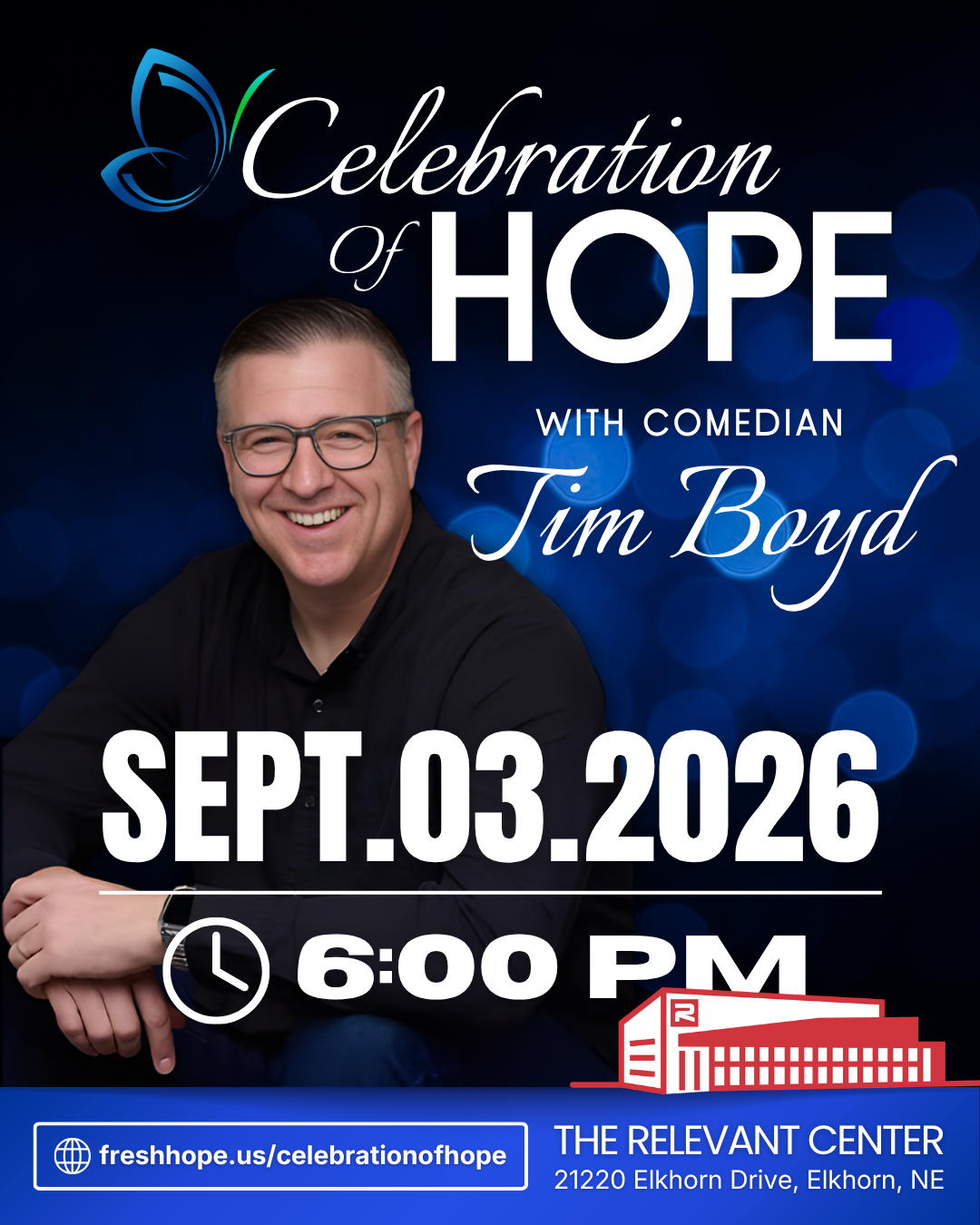
A fun night of music, comedy and giving!

Get ready for a special evening packed with big laughs, inspiring music, uplifting moments — and tons of hope!

¡Acompáñanos en nuestro evento Celebración de Esperanza el jueves 3 de septiembre de 2026, 2026 at 6:00 PM! Join us either in person at The Relevant Center en Elkhorn, NE, o de forma virtual desde tu computadora.

We are excited to announce we will have comedian, Tim Boyd as our special guests!

INSCRÍBASE EN LA PARTE SUPERIOR DERECHA DEL SITIO WEB

Webinar "Cómo pueden las iglesias facilitar el acceso a la atención de salud mental"

Regístrese aquí para ver gratis

Webinar "Lo que desearía que mi pastor supiera sobre salud mental"

Regístrese aquí para ver gratis

Dé el primer paso para crear su propia empresa
Grupo de apoyo Fresh Hope

Este campo tiene fines de validación y no debe modificarse.
Nombre(Requerido)
País(Requerido)

Por favor, rellene este formulario para que podamos proporcionarle más detalles sobre cómo iniciar un Ministerio Hope Coach.

Mejor momento para contactar

Introduce tus datos y nos pondremos en contacto contigo para que te conviertas en Hope Coach

Mejor momento para contactar

Lo que su donación puede hacer por
Esperanza para los desesperados

Por cada 32 centavos donados, podemos ofrecer esperanza durante una semana a una persona con un desafío de salud mental.

Por cada $16.64 donados anualmente, podemos ofrecer esperanza durante un año a una persona.

Cualquier cantidad que puedas donar ayudará a llevar esperanza a quienes la necesitan desesperadamente.

¿Qué tipo de donación te gustaría hacer?

Introduce tus datos para hablar con un Hope Coach

Mejor momento para contactar

Gracias por dar el siguiente paso
hacia la esperanza.

Queremos asegurarnos de que le enviamos la información que mejor se adapte a sus necesidades, así que tómese unos minutos para rellenar los datos que figuran a continuación.

(Tenga en cuenta que su privacidad es nuestra mayor preocupación. Fresh Hope nunca venderá sus datos y su información se mantendrá estrictamente confidencial).

Nombre

Dirección

Teléfono / Email

Lo que mejor me describe es lo siguiente