
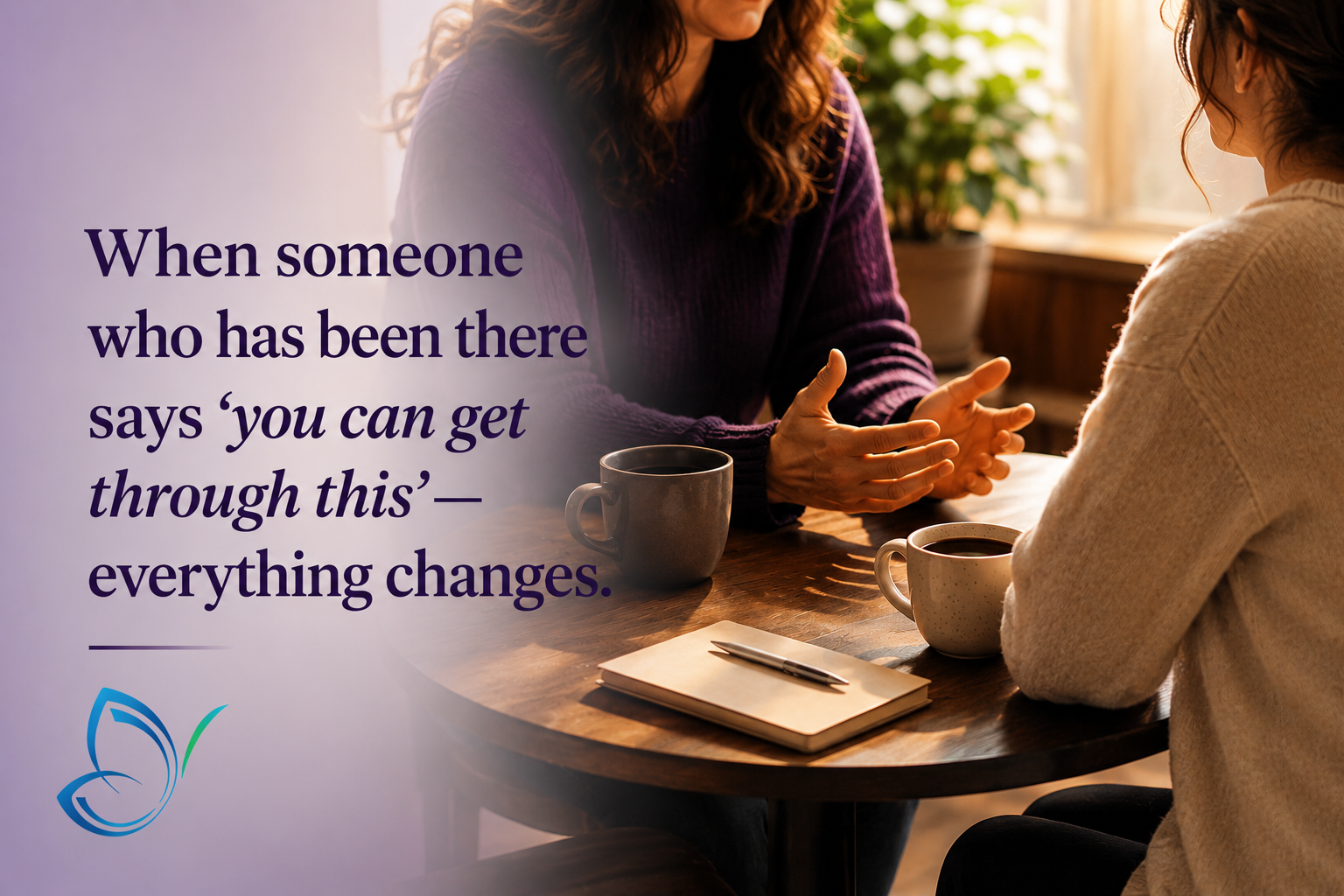
Peer support is now backed by more research than almost any other mental health intervention. But the numbers only tell part of the story. What really changes everything is sitting across from someone who has been where you are — and made it through.
| I am not generalized anxiety. You are not depression. You are not your diagnosis. You are a son, a daughter of God. You are chosen by God. And that is what this family reminds you — there is hope.
— Cintia, 32 — Ecuador, living with generalized anxiety |
Fresh Hope gives you insight into not only your diagnosis, but how to change your behaviors and your attitudes — and I think that’s truly important.
— Anonymous — United States |
Two voices. Two countries. One shared discovery: that what changed everything was not a new medication, not a more accurate diagnosis, not a better insurance plan. It was a community of people who understood — who could look them in the eye and say: I know. I have been there. And there is a way through.
This is the promise at the heart of the peer support model. And it is now one of the most well-documented interventions in all of mental health research.
The Science of Being Understood
The Sapien Labs Global Mind Health Report identifies social connection quality — not just quantity — as one of the strongest predictors of mental wellbeing. Having people in your life is not enough. Having people who genuinely understand your experience, who do not minimize it or spiritualize it away, who stay present through the hard seasons — that is what the data consistently points to as protective.
Peer support is the formal application of this principle. It brings together people who share a common experience — in Fresh Hope’s case, those living with a mental health diagnosis and their loved ones — and creates structured space for mutual encouragement, practical wisdom, and shared hope.
| = CBT | Research comparing peer support to cognitive behavioral therapy finds equivalent outcomes across multiple mental health conditions — including depression, anxiety, and bipolar disorder. |
| 52% | Of Fresh Hope participants who previously experienced suicidal ideation report complete resolution — no longer suicidal and no longer experiencing ideation. |
| 96% | Of weekly Fresh Hope participants report increased hope — the single most important predictor of long-term recovery outcomes according to peer support research. |
That 52% suicidality resolution figure is not a small number. It represents real people — people who once believed, like Gabriela in Blog 4, that there was no solution — who found their way to the other side of that darkness. And the instrument of their change was not primarily clinical. It was relational. It was someone who understood.
You Are Not Your Diagnosis
Of all the things that Fresh Hope offers, perhaps the most transformative is this: the direct, repeated, community-affirmed declaration that a person is more than their condition.
Cintia’s testimony is one of the clearest expressions of this in the entire collection. She has generalized anxiety disorder. She was told, by the culture around her and perhaps by the voice inside her head, that this made her weak. That having a diagnosis meant something was fundamentally wrong with her — not just medically, but spiritually, as a person.
| Fresh Hope is a ministry that teaches you, through the Word of God, that we are not weak — that we are people who need the Lord, and that the Lord has given wisdom to earthly doctors, but has also given His Word. Fresh Hope reminded me that I am not alone, that you can get out of this situation, and that there is hope.
— Cintia, Ecuador |
Notice the movement in Cintia’s testimony: from shame to identity. From “I thought having anxiety made me a weak person” to “I am not generalized anxiety — I am a daughter of God.” This is not a minor shift in self-perception. It is a fundamental reorientation of identity that changes how a person engages with their treatment, their relationships, and their future.
The peer support research calls this “identity reconstruction” — one of the core mechanisms by which peer support produces better outcomes than clinical care alone. When people in a peer community model recovered, purposeful identity, it gives those still in the struggle a vision of what is possible for them.
| You are NOT
your diagnosis |
You are NOT
your depression |
You ARE
a child of God |
This three-part declaration — embedded in Cintia’s testimony and in the culture of every Fresh Hope group — is not motivational language. It is a theological corrective to one of the most damaging lies that mental illness tells: that you are your condition, that your diagnosis is your identity, that the broken season defines the whole story.
Insight That Changes Behavior
The voice from the United States adds a dimension that is easy to overlook: Fresh Hope does not only offer emotional support. It offers insight — the practical, lived-experience wisdom that helps people understand not just their diagnosis, but what to do with it.
| Fresh Hope gives you insight into not only your diagnosis, but how to change your behaviors and your attitudes — and I think that’s truly important.
— Anonymous, United States |
This is a crucial distinction. Many support groups offer solidarity — a place to share pain and feel less alone. Fresh Hope offers that, and more: a framework for understanding the condition, tools for managing it, and accountability for actually applying what has been learned. Recovery Principle III captures this directly.
| PRINCIPIO DE RECUPERACIÓN DE FRESH HOPE III
My disorder can become an excuse. Therefore, I choose to believe I can live a full and rich life in spite of my disorder. I choose the support of people who will urge me to “push through”. Together we do better than trying on our own. We will hold one another accountable for learning, growing, and choosing to push through in hope. |
This principle names something uncomfortable: that even genuine suffering can sometimes become a reason to stop trying. The peer community creates the environment where that slide is gently, lovingly resisted. Not through judgment or pressure — Fresh Hope groups do not lecture or shame — but through the quiet testimony of people in the same room who are choosing, week after week, to push through.
The anonymous voice from the US points to this: behaviors change, attitudes shift. Not through willpower alone, but through insight applied in community. This is what distinguishes peer support from simple social connection — it is purposeful, structured, and oriented toward growth.
The Facilitator: A Living Proof
Every Fresh Hope group is led by a certified facilitator — someone who lives with a mental health challenge themselves, or who loves someone who does. This is not incidental to the model. It is the model.
The research on peer support consistently identifies the shared-experience credibility of the facilitator as one of the primary drivers of effectiveness. When someone says “you can get through this,” it lands differently depending on who is saying it. A clinician saying it is an expert opinion. A peer saying it — someone sitting across from you who has bipolar disorder type 1, or generalized anxiety, or depression, and who is living a purposeful, hopeful life — is a living proof.
This is what Cintia experienced. This is what Sergio found. This is what Norcángel offers when she tells a newly diagnosed person: there is hope, recovery is possible, you don’t have to walk this alone. She is not reading from a pamphlet. She is speaking from inside the story.
The Multiplication Effect
One of the most beautiful dimensions of the peer support model is what Principle VII describes: that sharing your story does not just help others. It helps you.
| FRESH HOPE RECOVERY PRINCIPLE VII
At times, my mental health challenge has caused me to focus only on myself and my needs, leading me to believe the lie that I don’t have much to offer to others. Therefore, because focusing on others will help me grow, I choose to give back, sharing my story with others, that my past pain might provide insights for someone else’s journey to living well. Together we recognize that sharing helps both us and others heal. Sharing helps us find our voice and becomes empowering as we see our pain redeemed by the Lord. |
The act of becoming the person who understands — of moving from the one who needed help to the one who offers it — is itself a therapeutic process. It reframes suffering as something that has purpose. It transforms what felt like wasted years into a resource for someone else’s breakthrough. It is, in the deepest sense, redemption.
This is why Fresh Hope does not just offer support groups. It trains facilitators. It multiplies peer supporters. It turns people who were once in the deepest darkness into the light that guides others through. Every facilitator is a former participant. Every group is a potential trainer of future facilitators. The model scales not through budget increases but through transformed lives.
A Word to Anyone Who Thinks They Have Nothing to Offer
If you are in the middle of your own struggle right now — if the idea of one day helping someone else feels impossibly far away — we want to speak directly to Principle VII’s opening line: the lie that says you don’t have much to offer.
The research on peer support says otherwise. Your experience — the very thing you wish you had never gone through — is precisely what will make you credible to the next person who walks through the door of a Fresh Hope group. Your story is not a liability. It is your most valuable asset.
| I am not generalized anxiety. You are not depression. You are not your diagnosis. You are a daughter of God. You are chosen by God.
— Cintia, Ecuador |
Cintia said this to encourage others. But she was also speaking to herself — reinforcing, out loud, in community, the truth that her diagnosis had tried to take from her. The sharing helped her as much as it helped everyone listening.
That is the power of someone who understands. Not just what they give to others — but what they become in the giving.
| NEXT IN THIS SERIES | BLOG 8 OF 10
You Are Not a Victim — You Are a Survivor With Purpose Living with a mental health diagnosis can make it easy to be defined by the condition. Fresh Hope teaches something different: that the disorder does not get the last word. Natalia from Colombia and Sergio from Guatemala share what it looked like to stop being defined by their diagnosis — and start living with purpose. |
SOBRE FRESH HOPE
Fresh Hope es una red internacional de grupos cristianos de apoyo mutuo para personas que viven con un diagnóstico de salud mental y sus seres queridos. Con más de 250 participantes semanales en más de 39 países, Fresh Hope integra principios de recuperación basados en evidencia con una comunidad centrada en la fe. Encuentra un grupo cerca de ti en freshhope.us
REFERENCIA DE LA INVESTIGACIÓN
Sapien Labs. Global Mind Health in 2025 [Salud mental global en 2025]. Febrero de 2026. sapienlabs.org
Comparte esta publicación: