
The wealthiest nations spend more on mental health than ever before — and their young adults are doing worse than ever before. Something fundamental is missing. And a woman from Venezuela living in Argentina has found it in three words.
| There are good days and there are very difficult days — and both are part of the process. If I could tell someone newly diagnosed three things: one, there is hope. Two, recovery is possible. Three, you don’t have to walk this alone.
— Norcángel, 37 — from Venezuela, living in Argentina, married, mother of a 4-year-old, living with bipolar disorder type 1 |
Norcángel did not receive her three words from a research institution. She did not get them from a clinical protocol or a government program. She found them in a Fresh Hope group — in the company of people who had walked the same road and survived it, and who were willing to say plainly what they had learned.
Those three declarations — hope, recovery, community — are not sentiments. According to the Sapien Labs Global Mind Health Report and decades of peer support research, they are measurable outcomes. And the fact that a volunteer-led, faith-based peer support ministry can deliver them, while trillion-dollar healthcare systems are struggling to, is one of the most important stories in global mental health today.
The Spending Paradox
The Sapien Labs data presents a paradox that should disturb everyone involved in mental health care: the countries that spend the most on mental health treatment have some of the worst mental health outcomes for young adults.
| $1T+ | Annual mental health spending in the United States — the highest in the world, and a country where young adult mind health ranks near the bottom globally. |
| Bottom 20% | Where the US, UK, Australia, and other high-spending Anglophone nations rank for young adult mind health scores among the 85 countries studied. |
| Top 20% | Where Sub-Saharan African and Latin American nations — with a fraction of the mental health infrastructure — rank for young adult mind health scores. |
This is not an argument against professional mental health care. Medication, therapy, and psychiatric support are real and necessary components of recovery — as Fresh Hope’s own Recovery Principles make clear. The question the data raises is different: why is enormous spending not translating into better outcomes?
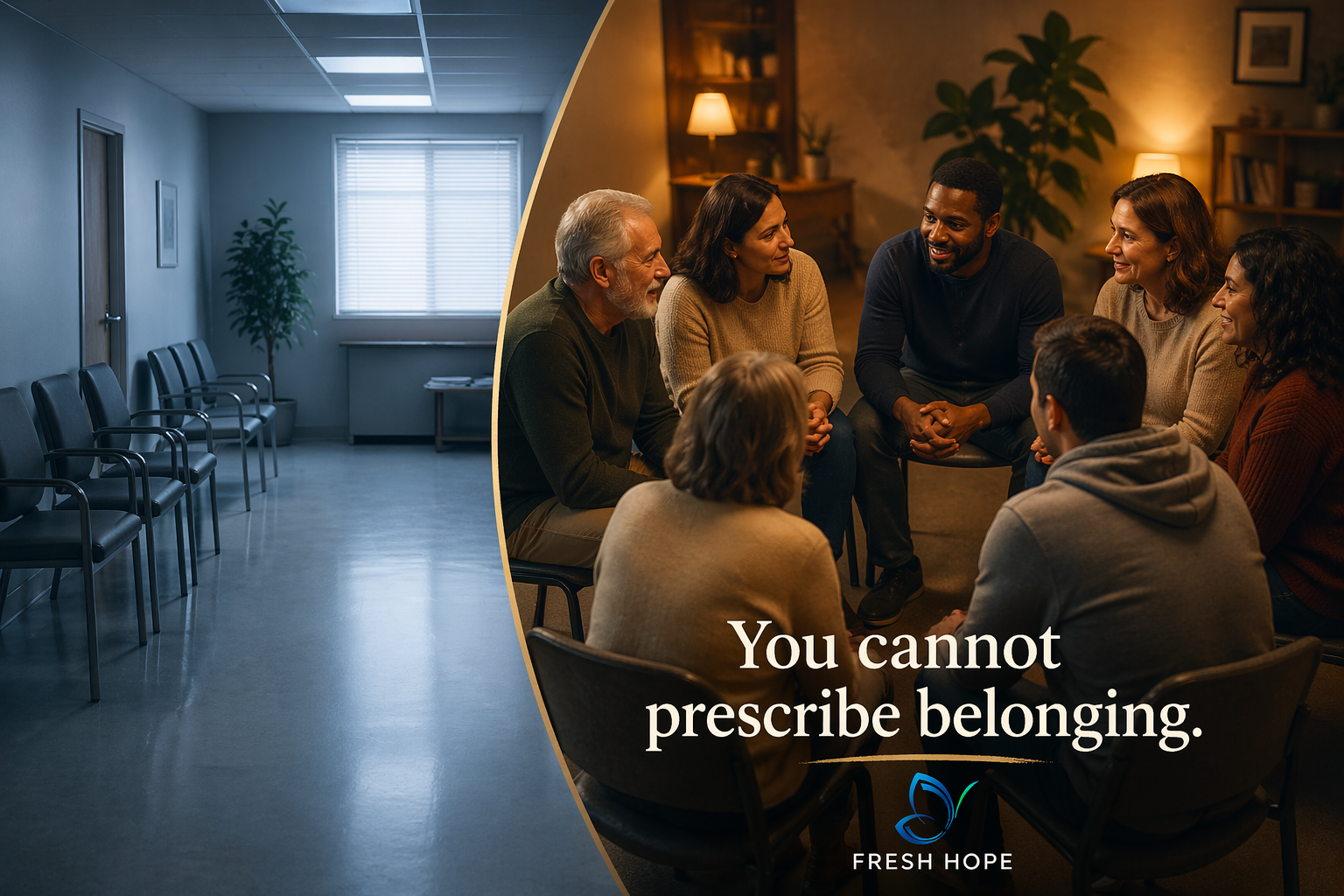
The answer, according to the Sapien Labs researchers, is that clinical systems — however well-funded — are almost entirely focused on treating symptoms once they appear. They are not designed to address the root causes of declining mind health: the erosion of spirituality, family bonds, embodied community, and whole-body wellness. You can prescribe a medication for depression. You cannot prescribe belonging.
What Money Cannot Buy
Consider what Norcángel’s three words actually represent when examined through the lens of the research.
| THERE IS HOPE
1 |
RECOVERY IS POSSIBLE
2 |
YOU DON’T HAVE TO WALK THIS ALONE
3 |
Hope — the first word — is not a feeling that a prescription produces. It is what happens when a person in crisis encounters someone who has walked the same road and come through it. The peer support research is extensive and consistent: being in community with people who share your experience and have found a way forward generates hope in a way that clinical encounters alone cannot replicate. Fresh Hope’s own internal research found that 96% of weekly participants report increased hope. That is not a medication side effect. That is what happens when people who understand each other sit in a room together.
Recovery is possible — the second declaration — is not a clinical prognosis. It is a lived testimony. When Norcángel says recovery is possible, she is not quoting a success rate from a pharmaceutical trial. She is speaking from her own experience of bipolar disorder type 1 — one of the more challenging diagnoses in the mental health landscape — and saying: I know it from the inside. This kind of testimony has a different weight than expert opinion. Research on peer support consistently shows that it improves outcomes precisely because the source of the message is someone who has lived it.
You don’t have to walk this alone — the third declaration — names the most fundamental failure of clinical systems. You can have access to world-class psychiatric care and still feel profoundly, devastatingly alone. Loneliness and isolation are among the strongest predictors of poor mental health outcomes in the Sapien Labs data. And they are precisely what Fresh Hope addresses — not through a service delivery model, but through genuine community.
The Peer Support Evidence
Fresh Hope is not simply offering a warm alternative to clinical care. It is operating according to a model that has substantial and growing research support.
| What Clinical Systems Primarily Offer
• Symptom assessment and diagnosis • Medication management • Individual therapy (when accessible) • Crisis intervention • Periodic appointments — not ongoing community • Professional expertise about the condition |
What Peer Support Adds
• Lived-experience wisdom • Ongoing weekly community • Mutual accountability and encouragement • Hope modeled by those who have recovered • Family and caregiver inclusion • Faith-based meaning and purpose framework |
Research comparing peer support models to traditional therapy has found that peer support equals or outperforms cognitive behavioral therapy (CBT) for a range of mental health outcomes — including reduced hospitalization rates, increased hope, and improved daily functioning. Fresh Hope’s own outcome data aligns with this: 92.3% of weekly participants find Fresh Hope more helpful than other support groups they have attended; 87.5% consider it crucial to their recovery.
These are not small numbers. They represent people who have tried other things — clinical care, other support groups, individual therapy — and found that the combination of peer wisdom, faith community, and the Fresh Hope framework delivers something those other approaches did not.
A Prophetic Model
There is something worth naming explicitly: Fresh Hope was not designed in response to the Sapien Labs data. It was designed in response to the gospel and to the lived experience of people struggling with mental health challenges who could not find a community that held both their faith and their diagnosis with equal seriousness.
And yet, point by point, the largest global mind health study ever conducted is confirming the wisdom embedded in the Fresh Hope model. Spirituality matters. Family bonds matter. Embodied, face-to-face community matters. Peer wisdom matters. Whole-person wellbeing matters.
| FRESH HOPE RECOVERY PRINCIPLE V
While medicine is a key component in my recovery, it is not the only answer. Therefore, I choose to explore new ways of thinking and acting in my relationships and daily living. Together we choose freedom over suffering, and joy in living through self-knowledge in action. |
Principle V has always said that medicine is key — but not the whole answer. This is not anti-medicine. It is pro-wholeness. The clinical world is beginning to catch up to what Fresh Hope practitioners have been living for years: that the human being cannot be healed in pieces. We are integrated creatures — spiritual, mental, relational, physical — and our healing must be, too.
What This Means for the Church
One of the most underutilized mental health resources in the world is the local church — and particularly churches in Latin America, Sub-Saharan Africa, and other regions where faith is still deeply woven into community life.
The Sapien Labs data suggests that these communities possess, in their cultural and spiritual DNA, many of the very things that protect and restore mental health: strong family bonds, active spirituality, face-to-face community, traditions of mutual care and accompaniment. What they often lack is a framework for applying these strengths specifically to mental health — a way of welcoming the person with a diagnosis and their family without judgment, and walking alongside them with wisdom and hope.
That is precisely what Fresh Hope provides. Not as a replacement for clinical care, but as the community infrastructure that clinical care cannot supply — the weekly presence, the peer wisdom, the faith foundation, the family inclusion that together create the conditions in which recovery becomes not just possible, but likely.
| Hay esperanza. La recuperación es posible. No tienes que caminar esto solo.
— Norcángel, Venezuela/Argentina |
Three words. No budget required. No clinical credential required. Just a person who has been through it, sitting across from a person who is in it, and speaking the truth that changed everything.
That is the model the data is pointing toward. That is the model Fresh Hope has been practicing for years. And for the communities that embrace it — the churches willing to open their doors, train their facilitators, and sit with people in their hardest moments — it may be the most important thing they do.
| NEXT IN THIS SERIES | BLOG 7 OF 10
The Power of Someone Who Understands Peer support is now backed by more research than almost any other mental health intervention. But the numbers only tell part of the story. Cintia, from Ecuador, and a voice from the United States share what it meant to be seen, known, and told: you are not your diagnosis. |
SOBRE FRESH HOPE
Fresh Hope es una red internacional de grupos cristianos de apoyo mutuo para personas que viven con un diagnóstico de salud mental y sus seres queridos. Con más de 250 participantes semanales en más de 39 países, Fresh Hope integra principios de recuperación basados en evidencia con una comunidad centrada en la fe. Encuentra un grupo cerca de ti en freshhope.us
REFERENCIA DE LA INVESTIGACIÓN
Sapien Labs. Global Mind Health in 2025 [Salud mental global en 2025]. Febrero de 2026. sapienlabs.org
Comparte esta publicación: