
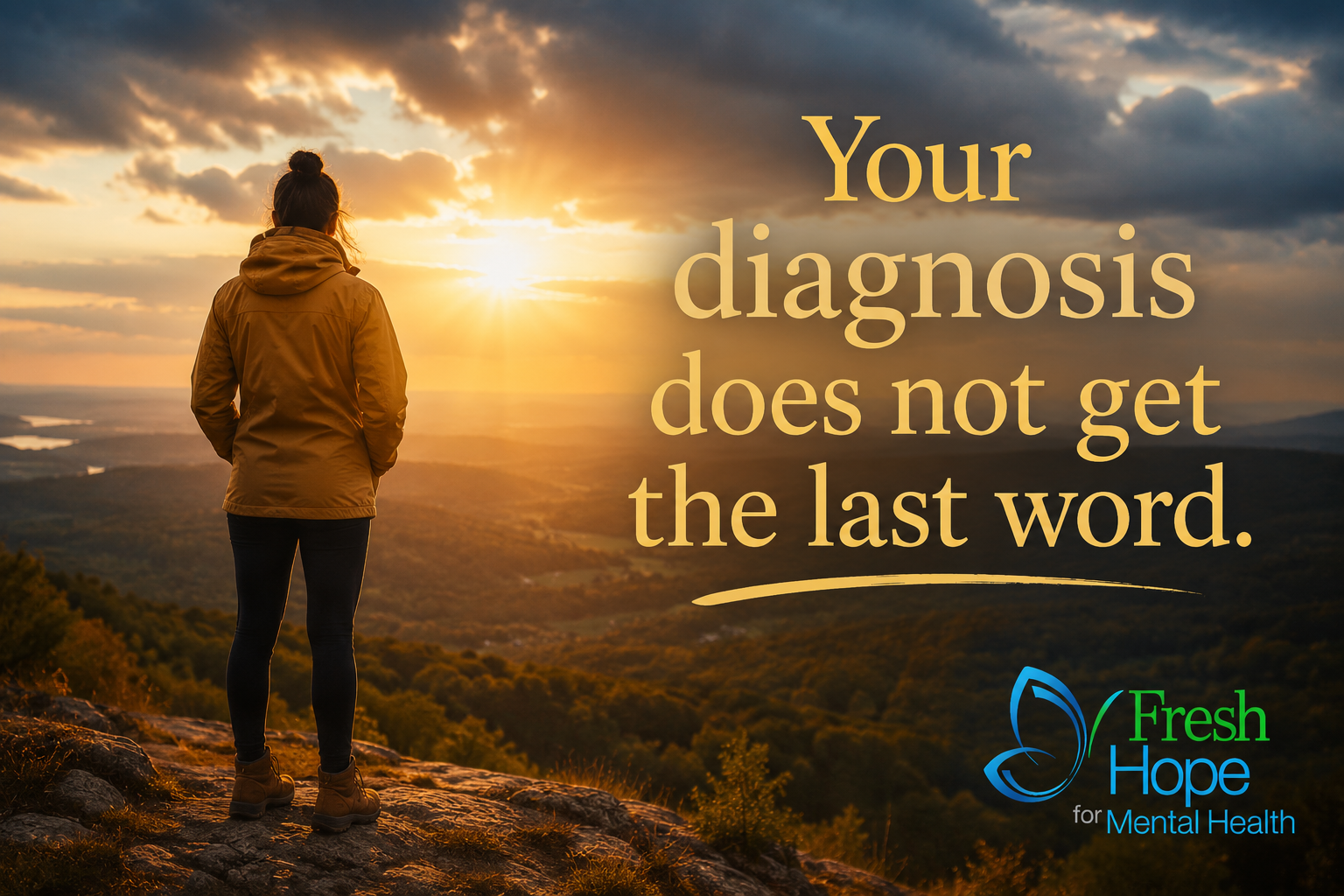
A mental health diagnosis can quietly rewrite a person’s identity — shrinking them down to their condition and cutting off their sense of future. Fresh Hope teaches something the research confirms: choosing to overcome is not denial. It is the most powerful decision a person can make.
| My diagnosis does not define me. I choose hope.
— Natalia, Colombia — living with bipolar disorder |
Depression and anxiety do not live in my life. Today I know that recovery is slow — but it is possible. And every small step forward counts.
— Sergio, Guatemala/Mexico — living with depression and generalized anxiety |
Between them, Natalia and Sergio have accumulated years of suffering, misdiagnosis, silence, and shame. Natalia spent years convinced that what she was experiencing was a spiritual failing. Sergio spent years showing up — working, smiling, fulfilling his obligations — while quietly falling apart inside. Both of them reached a point where they genuinely did not know if things could get better.
And both of them made a choice that changed the trajectory of everything. Not a single dramatic moment — but a decision, renewed day by day, to overcome. To not be defined by what they were living through. To choose hope when nothing in their circumstances required it.
This is what Recovery Principle VI is about. And it is also, according to the research, one of the most clinically significant decisions a person with a mental health challenge can make.
The Victim Identity and Why It Happens
Before exploring what Fresh Hope offers, it is worth being honest about why the victim identity is so easy to fall into — because it is not a character flaw. It is a completely understandable response to genuine suffering.
When a person receives a serious mental health diagnosis, their world often reorganizes itself around that diagnosis. Relationships change. Opportunities narrow. Plans are revised. Over time, it becomes natural to explain everything through the lens of the condition: why things went wrong, why opportunities were missed, why relationships broke down. The disorder becomes the story.
This is especially true in cultures — including many Christian communities in Latin America — where mental illness still carries significant stigma. When a person absorbs the message that their condition makes them lesser, damaged, or spiritually deficient, the victim identity is not just a coping mechanism. It is a survival response to a hostile environment.
| FRESH HOPE RECOVERY PRINCIPLE VI
At times I have allowed myself to become a victim, “defined” by my disorder. Therefore I choose to overcome and live in hope and joy, in spite of my disorder. At times, I have viewed myself as a victim of my loved one’s behavior and disorder, living in resentment, anger, unforgiveness, or self-pity. Therefore, I choose to separate the disorder from the person I love, forgive and let go of the past, and live as a contributor to successful recovery. Together, we share in each other’s victories and celebrate the whole person. “For God has not given us a spirit of fear, but of power and love and a sound mind.” — 2 Timothy 1:7 |
Notice what this principle does not do: it does not minimize the suffering. It does not tell people to pretend the disorder isn’t real, or to perform positivity they don’t feel. It says: at times I have allowed myself to become a victim. It acknowledges the pull toward that identity — and then, gently but firmly, invites a different choice.
The Research on Identity and Recovery
The connection between identity and recovery outcomes is one of the most robust findings in mental health research. Studies consistently show that how a person defines themselves in relation to their diagnosis is one of the strongest predictors of long-term functioning.
| 87.5% | Of Fresh Hope participants who previously considered their disorder a defining feature of their identity report a significant shift in self-perception after consistent group participation. |
| 0% | Of Fresh Hope participants in the suicidality outcomes study reported the same or worse ideation after participation — the entire cohort either improved or fully resolved. |
| 2 Tim 1:7 | The scriptural anchor of Principle VI — not a spirit of fear, but of power, love, and a sound mind — speaks directly to the identity question at the heart of recovery. |
People who identify primarily as a patient, a sufferer, or a victim of their condition tend to have more passive relationships with their treatment, lower rates of treatment adherence, and poorer long-term outcomes. People who identify primarily as a person who happens to have a condition — and who see themselves as active agents in their own recovery — consistently do better across every measurable dimension.
This is not a blame-the-patient argument. It is a recognition that identity is malleable, that it can be reshaped by community and by the stories we tell ourselves — and that peer communities like Fresh Hope are uniquely positioned to do that reshaping.
Natalia’s Choice
Natalia’s journey from diagnosis to purposeful living did not follow a straight line. She lived for years in a place of deep confusion — experiencing the real symptoms of bipolar disorder while being told by the culture around her that what she was living was a spiritual problem. The guilt she carried was not just about her condition. It was about who she believed she was.
| Today, having a diagnosis does not separate me from the love of God. On the contrary — it has taught me humility and compassion for others who struggle in silence. Today I know I can live with purpose even in the middle of my struggle.
— Natalia, Colombia |
The movement in Natalia’s testimony is remarkable. She does not say the bipolar disorder went away. She says it taught her something — humility, compassion, the capacity to see others who are struggling in silence. Her diagnosis became a teacher rather than a jailer. Her suffering became a resource rather than a verdict.
This is the shift that Fresh Hope facilitates: from a diagnosis that defines and diminishes, to a story that has been redeemed and now has purpose. It is not instant. It is not without pain. But it is real, and it is measurable, and Natalia is living proof.
Sergio’s Declaration
Sergio’s testimony contains one of the most striking lines in the entire collection — a declaration so clear and confident that it is worth reading slowly.
| Depression and anxiety do not live in my life. Today I know that recovery is slow, but it is possible. And every small step forward counts. I live with depression, I live with generalized anxiety — but depression and anxiety do not live in me.
— Sergio, Guatemala/Mexico |
Read that again: I live with depression, I live with generalized anxiety — but depression and anxiety do not live in me. This is not denial. Sergio is not pretending his conditions do not exist. He is asserting that they do not own the house. They are present — but they are not in charge.
This distinction — between having a condition and being defined by it — is precisely what the recovery research identifies as the tipping point. The moment a person stops saying “I am depressed” and starts saying “I have depression, and I am also a father, a friend, a man who loves God, a person with something to offer” — that reorientation is correlated with significantly better treatment engagement, social functioning, and long-term outcomes.
| DEFINED BY THE DISORDER
I am my diagnosis My condition defines my future I have nothing to offer others |
→ | LIVING WITH PURPOSE
I choose hope My diagnosis does not define me My pain has purpose for others |
This shift does not happen in isolation. It happens in community — in the presence of people who already hold that larger identity for you while you are still finding your way to it. It happens when Norcángel tells a newly diagnosed person: there is hope, recovery is possible. It happens when Cintia says: you are not your diagnosis, you are a child of God. It happens when Sergio, at 49, records a video testimony to tell someone he has never met: I made it through. And so can you.
For the Loved One: The Parallel Journey
Principle VI addresses not just the person with the diagnosis, but their loved ones — and it names something that caregiver communities rarely talk about openly: the victim identity that caregivers can develop alongside the person they love.
Resentment, anger, unforgiveness, self-pity — these are not signs of bad character in a caregiver. They are signs of a person who has been carrying an enormous weight without adequate support, framework, or community. Fresh Hope’s inclusion of loved ones in the same groups where the person with the diagnosis is finding freedom is not an accident. It is a recognition that both people need to make the journey from victim to purposeful survivor.
Beatriz and Marta, whose testimonies we heard in Blog 3, are both on this journey. The mother who prayed for years and found Fresh Hope as God’s answer. The mother who chose to walk alongside her son without being consumed by the struggle. Both of them choosing, in Principle VI’s language, to be contributors to successful recovery rather than collateral damage from the disorder.
A Word to Anyone Who Feels Defined by Their Diagnosis
If you have been living inside the story that your condition tells about you — if you have let the diagnosis shrink your sense of who you are and what is possible — we want to speak directly into that.
You are not your depression. You are not your bipolar disorder. You are not your anxiety. These are conditions you live with. They are real, they are hard, and they deserve serious treatment and support. But they are not the sum of your identity, and they do not get to write the ending of your story.
| My diagnosis does not define me. I choose hope.
— Natalia, Colombia |
Four words. The most concise summary of everything Recovery Principle VI, the peer support research, and the testimony of hundreds of Fresh Hope participants point toward. Not an absence of struggle. Not a denial of diagnosis. A choice — made in full awareness of what the condition is and what it costs — to be more than it.
That choice is available to you. And if you cannot quite make it yet on your own, Fresh Hope exists to be the community that holds it for you until you can — and then celebrates with you when you do.
| NEXT IN THIS SERIES | BLOG 9 OF 10
Latin America Has Something the World Needs The world’s largest mind health study identifies the very things that Latin American culture has always practiced — family, faith, community, shared meals — as the most powerful protectors of mental wellbeing. Four women from four countries share what that looks like from the inside. |
ABOUT FRESH HOPE
Fresh Hope is an international network of Christian peer-support groups for those living with a mental health diagnosis and their loved ones. With 250+ weekly participants across 39+ countries, Fresh Hope integrates evidence-based recovery principles with faith-centered community. Find a group near you at freshhope.us
RESEARCH REFERENCE
Sapien Labs. Global Mind Health in 2025. February 2026. sapienlabs.org
Share this Post: