
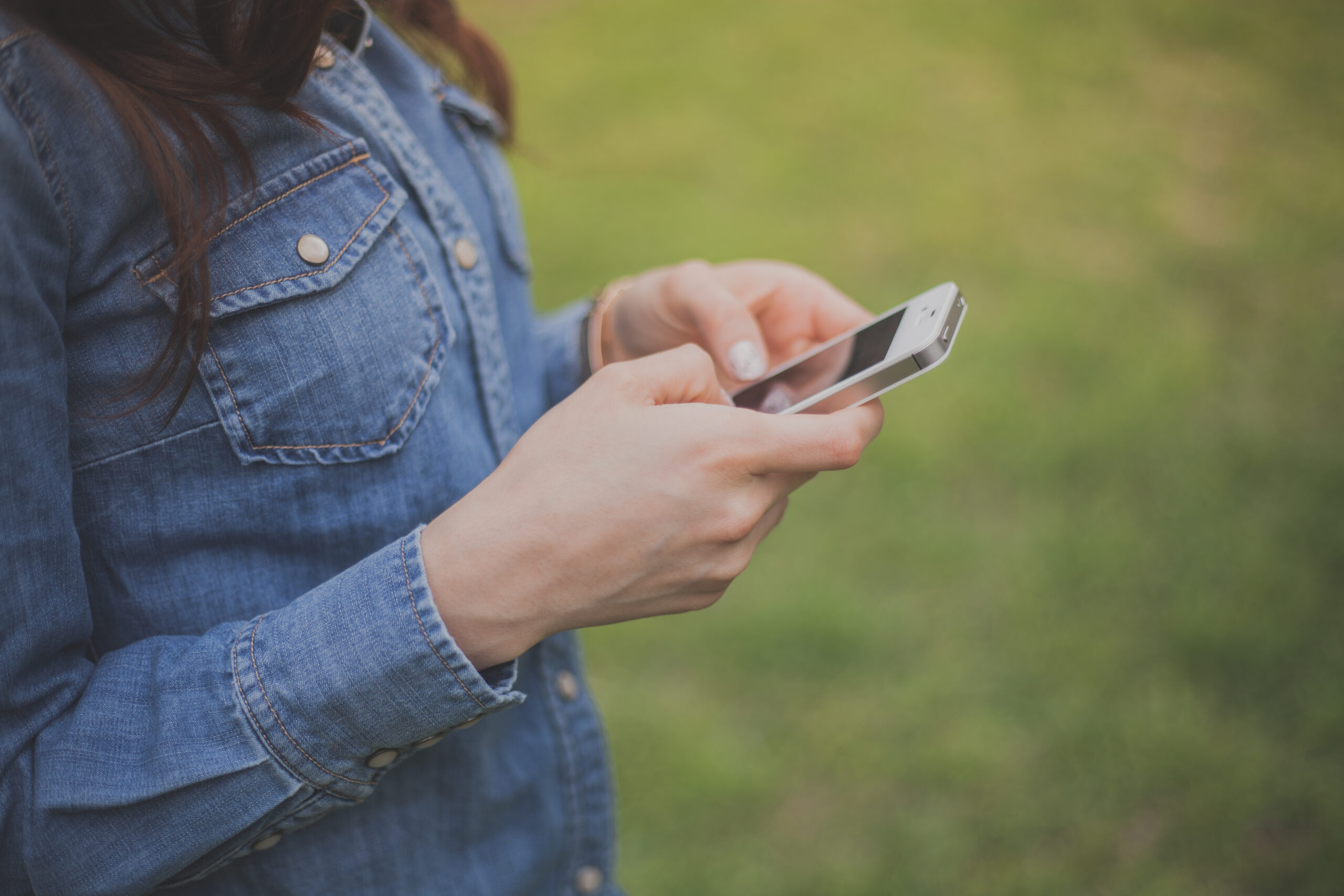
The world’s largest mind health study has found a disturbing link between early smartphone use and declining mental wellbeing. The antidote isn’t an app — it’s real human presence.
| Recovery is not linear. There are good days and difficult days — and both are part of the process. In Fresh Hope I found a support group, sisters who pray for me, who can also intercede for them. I found this beautiful ministry at a moment in my life when I truly thought there was no solution.
— Gabriela, 31 — Colombia, mother of a six-month-old, living with anxiety |
Gabriela is 31 years old. She is a business administrator, a daughter of God, and a brand-new mother — her baby was just six months old when she recorded her testimony. She is also a woman who, at some point before finding Fresh Hope, genuinely believed there was no way out.
Her generation — adults between 18 and 34 — is the most mentally distressed generation in recorded history, according to the Sapien Labs Global Mind Health Report. And the research is increasingly clear about one of the central reasons why.
The Smartphone Finding
Among the four root causes the Sapien Labs researchers identified for the decline in young adult mind health, the smartphone data is perhaps the most urgent — and the most actionable.
The study found a consistent, measurable relationship between the age at which a person first owned a smartphone and their mental health outcomes as an adult. The earlier the ownership, the worse the outcomes — across every country studied, across every income level, across every demographic group.
| Age 6 | Children who received their first smartphone at age 6 show significantly worse adult mind health outcomes than those who received it at age 13 or later. |
| 18–34 | Young adults in this age group — the first generation to grow up with smartphones from childhood — are the most mentally distressed demographic on earth. |
| 3× | Young adults who report high social media use show up to three times higher rates of emotional distress compared to those with low usage. |
The researchers are careful not to claim that smartphones cause mental illness in a simple, direct sense. The relationship is more complex. What smartphones do — particularly social media — is systematically replace the activities and relationships that protect mind health with activities that erode it.
Instead of in-person conversation, we get curated performance. Instead of family mealtimes, we get parallel scrolling. Instead of boredom that allows the mind to rest and create, we get infinite stimulation that trains the brain to crave novelty and tolerate discomfort less and less. Instead of the deep, embodied presence of another human being, we get a screen.
The Generation That Was Never Bored
There is something important that researchers are beginning to understand about the particular damage done by giving children smartphones before their brains are fully developed. The adolescent brain is in a critical period of formation. It is learning how to manage emotion, how to tolerate frustration, how to build identity, how to navigate conflict.
These capacities are built through experience — through the friction of real relationships, the awkwardness of face-to-face interaction, the slow development of patience and self-regulation. When a child has a device in their hand that delivers instant dopamine on demand, those developmental processes are disrupted.
| What the research links to early smartphone ownership:
Higher rates of anxiety and depression • Increased suicidal ideation • Greater difficulty with in-person relationships • Reduced ability to tolerate emotional discomfort • Lower scores on measures of empathy and social connection • Disrupted sleep patterns • Reduced sense of meaning and purpose |
None of this means that every young adult with a smartphone is destined for mental illness. But it does mean that the generation now in their 20s and early 30s — Gabriela’s generation — grew up in an environment that was systematically less protective of their minds than the one their parents experienced.
They are not weaker than previous generations. They were handed tools that damaged them before they had the capacity to use them wisely. And many of them are now carrying the consequences.
The Hidden Anxiety
What Gabriela describes in her testimony is textbook anxiety in the digital age: a sense that there is no solution, that the situation is inescapable, that something is fundamentally broken — even when the external circumstances of life look manageable. This is the anxiety that hides behind a functioning life, the kind that Sergio in Blog 1 described as smiling on the outside while feeling empty on the inside.
The Sapien Labs data links this pattern directly to high social media engagement. The constant comparison, the algorithmic amplification of outrage and fear, the performance of a curated life — these are not neutral activities. They are systematically training young adult minds to feel insufficient, unsafe, and alone, even in the midst of digital connection.
| I found this beautiful ministry at a moment in my life when I truly thought there was no solution. I thought I could not get out of my situation. But thank God He placed this ministry in my path — and in Fresh Hope I was able to learn to live always with hope, despite the challenges and struggles that can come because of my anxiety disorder.
— Gabriela, Colombia |
Notice what changed for Gabriela: not her diagnosis. Not her external circumstances. What changed was that she found a community — real, embodied, present people who prayed for her, interceded for her, and walked alongside her. The thing that broke through the anxiety was not digital. It was human.
Presence as Medicine
This is where the Sapien Labs research and the Fresh Hope model converge in a particularly striking way. The researchers found that the decline in mental health among young adults is not primarily about what is happening to them externally. It is about what is being lost — specifically, the quality of human connection that screens cannot replicate.
Fresh Hope groups meet in person. They gather weekly. They are facilitated by people who have walked the same road — who understand not just intellectually, but from the inside, what it means to live with a mental health challenge. They pray together, share stories, hold one another accountable, and celebrate each other’s victories.
In a world where an entire generation has been trained to process life through a screen, this kind of presence is countercultural. It is also, according to the data, exactly what struggling minds need most.
| FRESH HOPE RECOVERY PRINCIPLE V
While medicine is a key component in my recovery, it is not the only answer. Therefore, I choose to explore new ways of thinking and acting in my relationships and daily living. Together we choose freedom over suffering, and joy in living through self-knowledge in action. |
Principle V does not call people away from treatment. It calls them toward wholeness — a recognition that healing involves more than biochemistry. It involves how we think, how we relate, what communities we invest in, and what habits we form. In the smartphone era, this principle has never been more relevant.
A Word to Parents
The Sapien Labs findings have significant implications for parents — particularly parents in Latin America, where smartphone adoption has accelerated rapidly in the past decade and where children are receiving devices at increasingly young ages.
The data suggests that every year a child’s first smartphone is delayed is a gift to their developing mind. This is not about fear or restriction for its own sake. It is about protecting the developmental window during which children build the capacities — emotional, relational, attentional — that will serve them for the rest of their lives.
Family mealtimes without devices. Conversations that last longer than a notification. Boredom that is allowed to resolve itself into creativity rather than being immediately filled by a screen. These are not old-fashioned inconveniences. According to the largest mind health study ever conducted, they are among the most protective things a family can do.
A Word to Young Adults
If you are in Gabriela’s generation — if you grew up with a device in your hand before you had the tools to use it wisely — we want to say this clearly: what you are experiencing is not a personal failure. It is the predictable result of an unprecedented experiment in which an entire generation was the test subject.
And there is a way through. Not by deleting every app and living off the grid. But by intentionally rebuilding what screens have been eroding: in-person community, honest conversation, the slow and unglamorous work of showing up week after week for a group of real people who know your real name and your real story.
| In Fresh Hope I found sisters who pray for me — and I can intercede for them. Many tools that have helped me move forward. And I found it at a moment when I truly thought there was no solution.
— Gabriela, Colombia |
That is the testimony of someone who found the antidote. Not an algorithm. Not a mental health app. Sisters. Prayer. Tools for the journey. A community that showed up in person, week after week, and refused to let her face it alone.
The research calls this “high-quality social connection.” Gabriela calls it Fresh Hope. And she would tell you — they are the same thing.
| NEXT IN THIS SERIES | BLOG 5 OF 10
Food Also Affects Your Mental Health The Sapien Labs data identifies ultra-processed food consumption as one of the four root causes of declining young adult mind health — contributing 15 to 30% of the mental health burden globally. Sergio shares what learning to care for his whole self — without shame — has meant for his recovery. |
ABOUT FRESH HOPE
Fresh Hope is an international network of Christian peer-support groups for those living with a mental health diagnosis and their loved ones. With 250+ weekly participants across 39+ countries, Fresh Hope integrates evidence-based recovery principles with faith-centered community. Find a group near you at freshhope.us
RESEARCH REFERENCE
Sapien Labs. Global Mind Health in 2025. February
Share this Post: